Walk into any mattress showroom in India and one of the first questions you will be asked is how many inches you want. Six, eight or ten. It sounds like a simple choice, and most buyers answer it by instinct: thicker must be better. That instinct is only half right. Thickness tells you how much material is stacked inside a mattress, but it says very little on its own about how that mattress will actually feel or how well it will hold your spine. Two mattresses of the same depth can sleep completely differently depending on what fills those inches.
Here is a practical way to read the number, and how to work out which depth genuinely suits your bed and your body.
What those inches are actually made of
Every mattress is a stack. There is a core, which does the structural work of holding your body up, and there are comfort layers above it, which decide whether the surface feels plush or firm underneath you. The inches on the label are simply the total of the two.
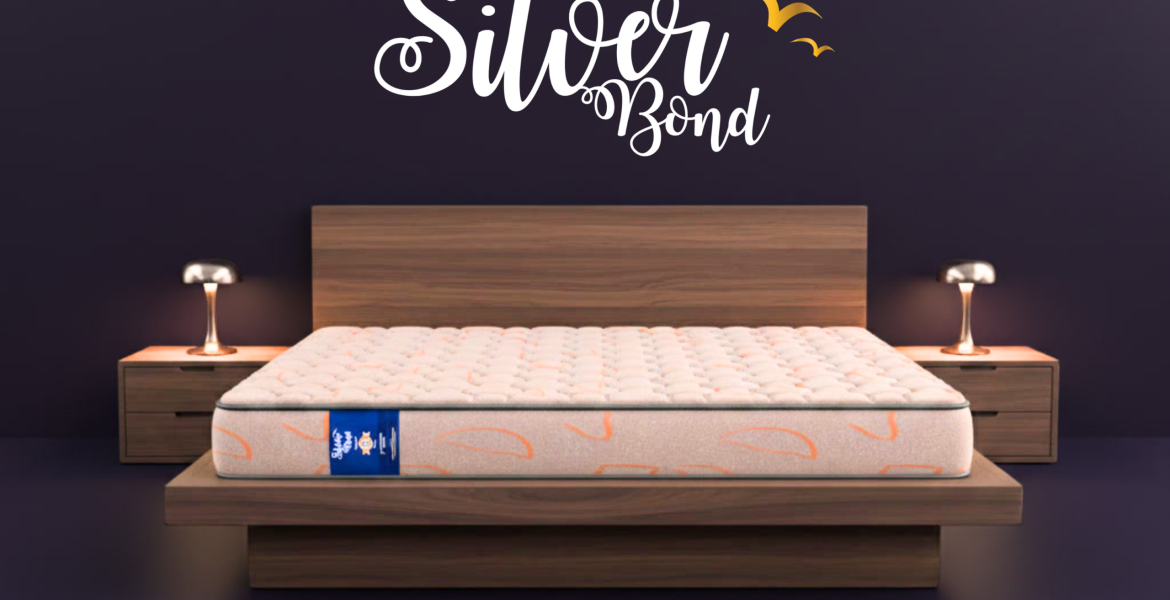
You can see this clearly by reading a spec sheet properly. The Silver Bond from the TrueLuxury Classic Series is built from high density foam, bonded foam and a quilted PU foam layer, and is offered in 5, 6 and 8 inches. The Posture Sense from the Tech Sense Series uses a charcoal infused HR foam core under multi layer quilted memory foam, and is offered in 6, 8 and 10 inches. Both ranges include a 6 inch option. They are not the same mattress at 6 inches, because the material doing the supporting is different.
So the useful question is not simply how thick, but how those inches are divided. A mattress with a deep, well built core and a thin comfort layer will feel supportive and firm. One with a shallower core and a generous quilted top will feel softer immediately, even at the same total depth. When you compare two options, look for the layer description before you look at the number of inches.
Why some ranges start at 8 inches
Not every construction is available in every depth, and that is a genuine engineering constraint rather than a sales decision. Across the TrueLuxury catalogue, the Smart Hybrid Series models such as Cool Hybrid, Dual Hybrid, Springy Hybrid and Latex Hybrid are listed only in 8 and 10 inch options. A hybrid combines a spring or zoned support system with several distinct foam layers above it, and that stack simply needs the height to work as designed.
The Tech Sense Series, by contrast, spans 6, 8 and 10 inches across its models, including the spring based Pocket Sense and Bonnel Sense as well as the foam and latex based Auto Sense, Sleep Sense and Nature Sense. The Classic Series goes thinner still, down to 5 inches on Silver Bond.
The takeaway for a buyer is straightforward. If you have your heart set on a particular construction, that will often decide your thickness for you, rather than the other way round. Choose the support system first and let the available depths follow.
Thickness does not decide longevity
This is where a lot of buyers go wrong. It is tempting to assume that a thicker mattress will simply last longer, and to pay for inches on that basis. The manufacturer warranty terms tell a different story.
Silver Bond, available up to 8 inches, carries a stated 5 year warranty. Posture Sense, which shares the same 6 inch entry point, carries a stated 11 year manufacturing warranty. The Expert Series Pocket Spring carries 8 years, while Zeta Luxury from the same series carries 11. The warranty tracks the series and the quality of construction, not the depth. A thicker mattress made from ordinary material is still a thicker mattress made from ordinary material.
If durability is your priority, read the warranty term and the layer composition. Those two lines will tell you far more than the inch count will.
Matching depth to your bed and your household
The last consideration is entirely practical, and it is the one most often forgotten until the mattress arrives.
- Storage and box beds. Many Indian bed frames have a raised lip or a hydraulic storage box. A 10 inch mattress on a deep frame can sit high enough to make getting in and out awkward, and can make fitted sheets difficult. Measure the internal depth of the frame before you order.
- Diwans and low platforms. A thinner profile often looks and works better here, which is part of why the 5 and 6 inch options exist at all.
- Guest rooms and occasional use. A room used a few nights a month rarely justifies the deepest option. For genuinely occasional or floor use, a Three Fold Mattress in high resilience foam folds away entirely, which a fixed mattress cannot do.
- Hostels, PGs and staff rooms. Durability and ease of handling usually matter more than plushness, and mid range depths are easier to move up staircases.
- Two adults sharing. Look at the support system rather than the depth. Individually encased pocket springs are designed to limit motion transfer between partners, and that has nothing to do with how many inches the mattress measures.
A simple order of decisions
If you work through the choice in this sequence, thickness stops being confusing. Decide who is sleeping on it and what support they need. Choose the core material and support system that suits that need. Check which depths that construction is offered in. Then measure your bed frame and pick from what is left.
Thickness is a useful filter. It is a poor first question. Get the construction right, and the right number of inches tends to be obvious by the time you reach it.