A mattress can only hold your spine in line as far as your shoulders. Everything above that — the last fifteen centimetres of the sleep system — is the pillow’s job, and it is the part most buyers leave untouched. It is common to spend weeks comparing foam densities and spring types, take delivery of a new mattress, and then put the same four-year-old pillow on top of it. The result is a bed that feels better under the hips than under the neck, and an owner who quietly suspects the mattress was a mistake.
The pillow costs a fraction of what the mattress does, and it goes wrong far faster.
The pillow’s real job is filling a gap
Lie on your side and picture the space between the outer edge of your shoulder and the side of your head. That gap is what the pillow has to fill — no more, no less. Fill it correctly and the neck continues the same straight line as the rest of the spine. Under-fill it and the head drops toward the mattress, bending the neck downward all night. Over-fill it and the head is propped up and the neck bends the other way. Either way, the muscles along the side of the neck spend eight hours holding a position instead of resting.
Because that gap depends on shoulder width, side sleepers usually need more height than back sleepers. It also explains why the right pillow changes when the mattress does: a softer surface lets the shoulder sink further in, closing the gap, so a pillow that suited a firm ortho mattress can feel too tall on a plush one. If you have just switched mattresses and your neck feels worse rather than better, test the pillow before you blame the mattress.
The second job is holding that height until morning. A fibre pillow fills the gap beautifully at bedtime and compresses under load; by two in the morning, the height you chose is not the height you have. This is where the fill material stops being a specification-sheet detail.
What memory foam does differently
Memory foam is viscoelastic: it softens under pressure and warmth exactly where load is applied, then returns to shape once that load is removed. In a pillow, the foam yields under the heavy back of the skull while staying firmer under the lighter, unsupported curve of the neck. Rather than one flat height across the whole pillow, you get a surface that has shaped itself into the gap.
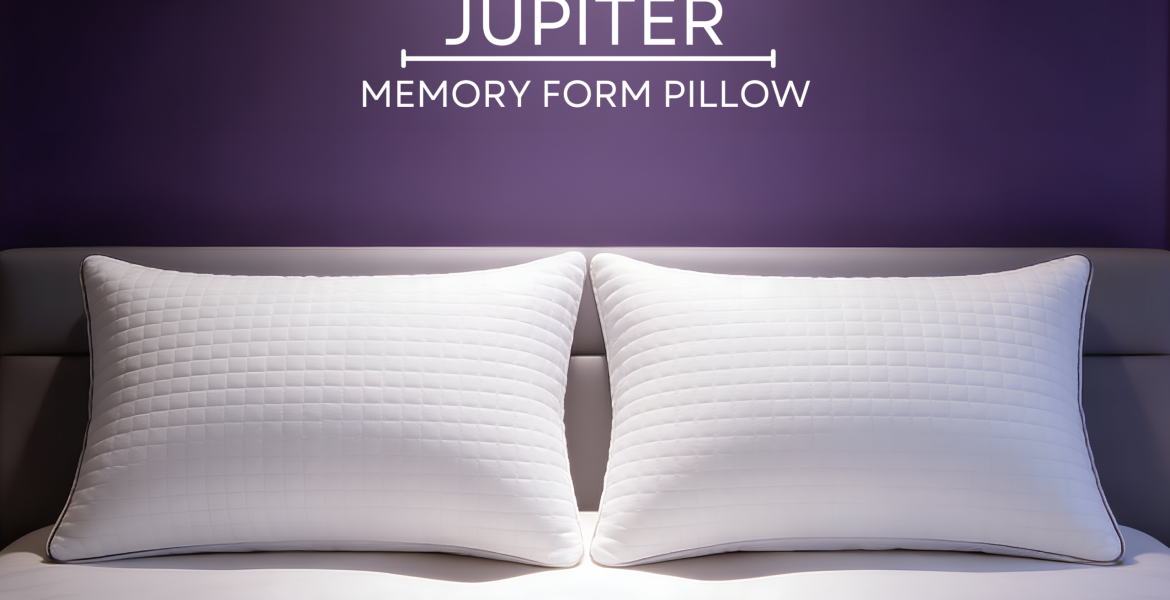
The JUPITER pillow is built on that principle. Its listed specification is high-density memory foam filling, a medium-firm feel, a soft knitted fabric cover, orthopaedic neck and spine support as the design intent, and a pressure-relieving, shape-retaining character. Density is the line worth pausing on. Low-density foam contours just as readily but tires quickly, losing its ability to push back; higher density is what keeps a contouring pillow behaving in month eighteen the way it did in week one.
Two things follow in practice. A memory foam pillow feels firmer on a cold January night than in humid August, because the material is temperature-responsive; a few minutes under your head usually settles it. And it does not reward being folded or punched into shape the way a fibre pillow does — the design assumption is that the pillow shapes itself to you.
Who it suits, and who is better served by something else
JUPITER is listed as best suited to neck pain relief, premium sleep, and side and back sleepers, which maps closely to how the material behaves. Side sleepers have the largest gap to fill and gain the most from a fill that holds its height. Back sleepers get a surface that cradles the base of the skull without pushing the chin toward the chest. Anyone who wakes with a stiff neck that loosens within an hour of getting up is describing a positioning problem, and positioning is what a contouring pillow is designed to address. Neck pain that is severe or persistent is a matter for a doctor, not a pillow.
Stomach sleepers are the clear exception. That position already turns and extends the neck, and adding height makes it worse. A low, soft pillow — or none at all — is kinder.
Preference matters too, which is why the range is a menu of fill materials. VENUS uses ultra-fine microfiber and is listed as soft, for sleepers who want a plush, hotel-like feel rather than structure. PLUTO is a premium soft fibre pillow with a similarly plush feel. MARS is high-resilience PU foam at a medium firmness — supportive and consistent, without the slow-sinking sensation some people dislike in memory foam. BOOSTER is a medium-soft polyester fibre pillow built for extra loft, useful for broad-shouldered sleepers or as a second pillow. If memory foam has felt too enveloping before, MARS is the closest alternative that still holds a defined shape.
Buying it well, and keeping it working
Judge a pillow on the mattress you actually own, in the position you actually sleep in — thirty seconds lying down tells you more than squeezing it between your hands at a counter. Have someone look at your neck from the front while you lie on your side: it should continue the line of your spine, not angle up or down.
Give a new memory foam pillow about a week before judging it — the body adapts to a familiar wrong height and briefly reads a correct one as strange.
- Protect the foam with a washable pillow cover and clean the cover, not the core.
- Do not soak or machine-wash a memory foam pillow — spot-clean marks and let it air.
- Replace pillows on their own schedule, not the mattress’s.
A pillow that no longer returns to shape has stopped doing its only job. Getting that last fifteen centimetres right is the cheapest improvement available to most sleepers — and often the one that finally makes a good mattress feel like one.